
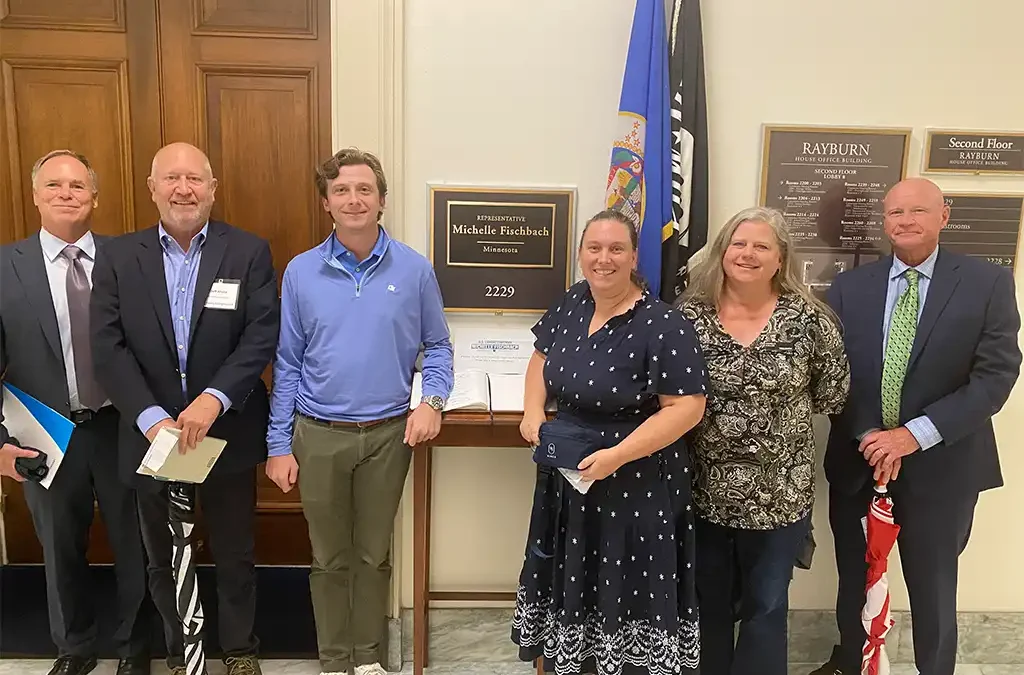
Make Your Voice Heard on Capitol Hill
Overview: The Congressional Family Business Caucus met on September 23, 2026, in the Dirksen Senate Office Building. The meeting, which saw Rep. David Min (D-CA) become the 50th House member to join the bipartisan Caucus, focused on the themes “The Price of Prosperity” and “Family Business Strategies for Battling All Taxes on Success.”
Over 50 family business leaders were in attendance, along with lawmakers and legislative experts, to hear discussions and presentations on such family-owned businesses issues as wealth taxes, voter attitudes, and how the post midterm legislative agenda will affect family-owned businesses next year.
Featured lawmakers at the event were Rep. David Kustoff (R-TN) and Rep. Jimmy Panetta (D-CA), who shared their overviews of the upcoming midterms and their impact on families of family-owned businesses.
The Caucus, the last for the 119th Congress, is co-chaired by Rep. Lou Correa (D-CA) and Rep. Claudia Tenney (R-NY) and is comprised of 22 Democrats and 28 Republicans. Family Enterprise USA was the organizer of the Caucus.
The morning session began at 8:30AM with an overview of the day and agenda provided by Tim Schultz, Chief Executive Officer, Family Enterprise USA. Schultz also welcomed and introduced Pat Soldano, President, Family Enterprise USA, who helped lead discussions, along with John Gugliada, Director of Engagement, Family Enterprise USA.
“It’s important Members of Congress, including those in the Senate, understand what a powerful economic engine family-owned businesses are for our country, and these Caucus meetings help craft policies that keep them strong and growing,” said Schultz in his opening remarks.
This led into legislative updates provided by Capitol Hill insiders from the legal and government affairs firm Brownstein, featuring the firm’s shareholder and legislative tax expert Russ Sullivan.
Morning Session: Legislative Updates
Russ Sullivan and the Brownstein legal team provided attendees with a detailed overview of midterm election dynamics, including Congressional retirements, “safe seats,” key swing states and voter behaviors. The legal team included Bart Reising, former Policy Director for Majority Leader Scalise, Nadeam Elshami, Chief of Staff for former Speaker Pelosi. It also included Brownstein team members Dave Ransom and Jared Jones who spoke on advocating and the correct ways of working with House Members.
The legislative discussion touched on a wide range of issues. When it came to Congressional Retirements and “Safe Seats” it was discussed how Members of Congress often retire due to age, seeking higher office (such as Senate seats or governorships), or frustration with legislative gridlock.
Most current retirements occur in designated “safe seats” for either Republicans or Democrats. Unlike traditional cycles where retirements signaled a hostile political climate for the majority party, present-day retirements are driven more by individual career pivots.
When it came to “Key Swing States and Target Districts Races” in states like Pennsylvania, Virginia, Wisconsin, and Maine, the presenters showed they serve as major indicators for control of the House. Out of all House districts, the vast majority fall into safe or leaning categories, leaving approximately 21 toss-up seats that ultimately decide the House majority.
As for “Voter Behavior and Campaign Narratives” the Midterm elections are heavily driven by economic factors and voter emotion, such as rising costs for diesel, gasoline, food, and everyday goods, the presenters said. Campaign strategies frequently focus on tying opposing candidates to radical or polarizing figures within their broader party to influence voter turnout.
“Legislative Mechanics & Congressional Agenda”
Part of this discussion focused on the Budget reconciliation process. Budget reconciliation allows the party in power to pass major policy initiatives regarding taxes and spending using a simple majority threshold (50 votes plus a tiebreaker in the Senate) rather than the standard 60-vote filibuster threshold.
The wide-ranging review also included the “Funding Crisis Timeline” related to Social Security and Medicare benefits, including legal implications of deficits, expected reform timing, and obstacles in Congress. They also addressed the historical precedent for bipartisanship related to Social Security. In the 1980s, leaders like President Ronald Reagan and Tip O’Neill successfully agreed to curb partisan attacks to negotiate a long-term Social Security compromise that lasted for decades.
A key part of the discussion also focused on Federal Tax Revenues & Expenditure Trends. An overview on primary sources of Federal Revenue was provided including details on Individual Income Taxes, showing Form the largest share of federal revenue (roughly 50%), paid primarily by top income earners.
A breakdown showed Payroll Taxes represent the second-largest share (roughly one-third), funding Social Security and Medicare, capped at specific income thresholds for Social Security. Corporate Income Taxes & Customs Duties Account for smaller portions of total federal revenue, with customs duties fluctuating based on trade policy and tariff implementations.
The presenters showed how Federal Spending and Structural Deficits Outlays expanded dramatically following emergency spending in 2020 and have remained elevated due to defense spending and growing entitlement programs (Social Security and Medicare) as the population ages.
As a result, attendees were shown how revenue growth has not kept pace with outlays, leading to persistent annual budget deficits exceeding $1 trillion.
Lastly, they reviewed “Estate & Private Wealth Tax Planning Strategies,” including the multi-layered “Tax Stack.”
The “stack” includes annual Income Taxes paid on operational income generated by business entities, Capital Gains/Exit Taxes realized upon asset sales, business exits, or depreciation recapture, an Estate Tax levied on net wealth transferred upon death above applicable exemption thresholds. Lastly, there is a Generation-Skipping Transfer (GST) Tax, which is an additional tax layer on assets transferred to grandchildren or subsequent generations, designed to prevent wealth from skipping a tax generation.
The Brownstein presenters also discussed “Wealth Preservation Structures & Tools,” such as Intentionally Defective Grantor Trusts (IDGTs), Grantor Retained Annuity Trusts (GRATs), and Basis Step-Up Management.
EY Presentation: “The Cumulative Tax Burden”
The event also featured EY’s Dianne Mehany, Private National Tax Leader at consulting firm EY, who presented on “The Cumulative Tax Burden,” a topic that covered how income, estate, gift, and transaction taxes add up on family-owned businesses across generations, and how high-leverage planning can create opportunities.
Mehany discussed “Timing as Leverage.” Her discussion focused on timing serving as a major point of leverage; waiting until a significant amount of value has already been built can cause people to miss opportunities to reduce future generational taxes. Also, choosing the right entity structure is critical during the building phase of a business.
Mehany also detailed key S Corporation Considerations. While S corporations are popular pass-through vehicles that allow for state planning to reduce state taxes, they may not always be optimal depending on long-term business and family goals.
When it comes to family governance, Mehany said family business owners should evaluate if their current entity structure supports family dynamics, especially when addressing differences between children who want to participate in the business and those who do not.
Understanding family compensation is also essential to carefully structuring compensation for family members who join and contribute to the business, she said. She also detailed reinvestment and tax rates in a business while paying individual taxes at the highest rate requires evaluating whether the chosen business structure remains the best option.
House Members Kustoff and Panetta Address Attendees
Featured lawmakers at the event were Rep. David Kustoff (R-TN) and Rep. Jimmy Panetta (D-CA), who shared their views on the upcoming midterms and their impact on families of family-owned businesses.
Rep. Kustoff addressed the group by first expressing his gratitude to Family Enterprise USA and the attendees for participating, learning, and advocating.
Rep. Kustoff focused his talk on the Importance of Advocacy, emphasizing the critical importance of their presence and advocacy work. The House Member provided some historical context offering a story about how advocacy by a family business leader led to a change of policy.
Rep. Panetta also provided his personal view and appreciation for engagement for advocacy in the legislative process.
Rep. Panetta also expressed his gratitude to Family Enterprises USA, to Russ Sullivan, and to attendees for visiting Capitol Hill to advocate for family businesses and maintain faith in the legislative system. Rep. Panetta shared his personal family heritage and immigration story, detailing how his grandfather, Carmelo Panetta, who immigrated from Italy to Ellis Island in 1921 with $5 in his pocket, moved to California, and started a family restaurant.
The House Member also discussed the importance of family businesses and the American Dream, highlighting how family businesses act as the foundation for the American Dream by striving to give future generations a better life.
He also discussed impact of family businesses on communities, detailing how family businesses support local communities by providing first jobs and employment opportunities to local youth, drawing from personal experience working at local businesses in Carmel Valley, California.
New Research: Dr. Frank Luntz
Dr. Frank Luntz, the well-known communications consultant and pollster, presented his views on the political landscape and new research on what Americans will be thinking when they vote this November.
Luntz gave attendees a particularly alarming report on the state of America’s mindset. Luntz presented new research among 1,000 voters which showed voters “don’t want more taxes, they want our government to better manage the funds it already has and stop the wasteful, uncontrolled and unaccountable spending.”
Other findings focused on the barrage of wealth tax proposals in both state and federal chambers. Luntz’s observations were tough: “Wealth taxes could push good American jobs out of America” and “don’t punish success, rather protect opportunity.”
Luntz key points focused on “Respecting Struggling Individuals.” He said, “addressing affordability issues starts with showing respect for those facing financial challenges.”
Luntz also detailed how it’s important to “Restore Belief in Opportunity.” He told attendees that the core foundation of society is ensuring everyone “has the opportunity to achieve prosperity if they work for it, people will offer support if they perceive that the next generation will have a better future than their own,” he said.
He also addressed economic pessimism. Currently, more than half of Americans (nearly a 3-to-1 ratio, his research showed, believe their children will be worse off than them. It is difficult to get support from people who feel their children’s future is being destroyed, he added.
Countering progressive and socialist narratives was another topic he highlighted. “Socialists gain traction not just by arguing that conditions are bad, but by suggesting that things will continue to worsen,” said.
Luntz recommended a new focus on education and values. He offered that the recommended response to economic pessimism is ensuring young people are fully educated, well-informed, and grounded in core values like honesty and integrity.
Emphasizing character and creeds, like West Point cadets, were highlighted as examples of high integrity, adhering to a strict creed against lying, cheating, stealing, or tolerating those who do.
Family Business Panel Discussion
A panel of four family-owned business leaders shared strategies on maintaining businesses growth, tax concerns, and solutions for passing their businesses on to the next generation. The panelists were Jeff Ahola, of Ahola Corporation, George Gleason, II, of Bank OZK, John-Paul Lake of Rain for Rent, and Casey Roscoe of Gerking Ranch.
Jeff Ahola, of Ahola Corporation, discussed ESOP Adoption and how smaller businesses can utilize partial or full Employee Stock Ownership Plans (ESOPs) to share ownership with employees.
He also discussed 401(k) Regulations, including Current 401(k) regulations, Actual Deferral Percentage (ADP), and Actual Contribution Percentage (ACP) tests. Many of these issues make it difficult for business owners to set aside enough retirement funds to pass a business down to the next generation without needing to sell it.
He also touched upon “Avoiding External Funding,” where owners often seek to remain “evergreen” businesses to avoid relying on private equity investments or minority stakeholders when transitioning ownership.
Another subject was “Job Security Amid AI,” and how addressing employee anxieties surrounding AI-driven shifts and potential job losses can be managed by offering job guarantees while still integrating AI into operations.
George Gleason, II, of Bank OZK, spoke on “Personal and Family Financial Planning” and how developing a game plan for timing family estate and tax planning decisions can be developed based on election outcomes and projections for future tax policy.
He also discussed business tax calculations, including calculating state-level taxes, cost of capital, and tax rates across various jurisdictions using apportionment formulas.
Lastly, he highlighted the impact of tax policy on business pricing, including factoring state tax rates into business pricing, resulting in higher credit costs for customers in high-tax states such as New York or California.
John-Paul Lake, of Rain for Rent, detailed the “Transitioning to Non-Family Leadership” and how bringing in a non-family CEO for the first time can be very difficult and may not succeed initially. This, Lake said, requires perseverance from the family/shareholders until the right fit is found.
He also focused on alignment between shareholders and executives, that is how shareholders must spend time with the CEO and executive team so they understand personal values and can serve as ambassadors for those values through both word and action.
Lake also detailed the importance of executive visibility, including how Leaders should prioritize being visible across the organization. For example, a new CEO demonstrated strong leadership discipline by traveling extensively to visit tens of branch offices early in his tenure to hold one-on-one meetings with employees.
He also mentioned how validating data through direct engagement is vital. A CEO can check, he said, and validate HR employee engagement survey data by directly asking employees their own methodical set of questions during face-to-face check-ins.
Finally, Lake discussed how connecting employee experience to customer experience is vital. Employees will only treat customers as well as they are treated by leadership, and how focusing on employee retention is equally important. Additionally, companies should strive to continuously improve employee retention while maintaining a strong culture of performance and accountability.
Casey Roscoe, of Gerking Ranch, focused on tax burden distribution, highlighting that the top 10% of earners pay 72% of federal individual income taxes.
Roscoe added that government financial support shows that around 50% of U.S. households receive money from the government, which includes government employees, subcontractors, contractors, and benefit recipients.
She offered an appeal to lawmakers, urging members of Congress and senators to support taxpayers and enable them to continue contributing to the economy rather than enacting punitive policies.
Roscoe also warned against state or federal governments implementing an “asset seizure tax,” or Wealth Tax, a phrase to which many attendees responded favorably.
Caucus Meeting Ends & Afternoon House Member Meetings
After the morning Caucus meeting and lunch, family business attendees broke into smaller groups and were led to their districts’ House Member offices to discuss in-person key issues affecting their family businesses.
The House Member in-person visits concluded at 4PM and which time the official Congressional Family Business Caucus Meeting and House Member meetings concluded for the 119th Congressional Congress.
We hope you've enjoyed this article. While you're here, we have a small favor to ask...
As we prepare for what promises to be a pivotal year for America, we're asking you to consider becoming a member.
The need for fact-based reporting of issues important to family owned businesses and protecting a lifetime of savings has never been greater. Now more than ever, successful families and family owned businesses are under fire. That's why Family Enterprise USA is passionately working to increase the awareness of issues important to family owned businesses built on hard work, while continuing to strengthen our presence on Capitol Hill. The issues we fight for or against with Congress in Washington DC include high income tax rates, possible elimination of valuation discounts, increase in capital gains tax, enactment of a wealth tax, and the continued burden of the gift tax, estate tax and generation skipping tax.
Family Enterprise USA promotes generationally owned family business creation, growth, viability, and sustainability by advocating for family businesses and their lifetime of savings with Congress in Washington DC. Since 2007, Family Enterprise USA has represented and celebrated all sizes, professions and industries of family-owned enterprises and multi-generational employers. It is a bi-partisan 501.c3 organization. Family foundations can donate.