
Make Your Voice Heard on Capitol Hill

Family enterprises are often guided by a purpose that extends beyond profit — creating lasting value for employees, communities and future generations. As ownership expands and generational transitions introduce new complexities, families increasingly need governance structures that balance continuity, accountability and long-term stewardship while preserving the flexibility that private ownership provides.
EY Family Enterprise Business Services supports business-owning families as they establish the frameworks needed to navigate growth, succession and evolving ownership dynamics. From family councils and advisory boards to independent directors and formal boards, effective governance can strengthen decision-making, prepare future leaders and support long-term ownership.
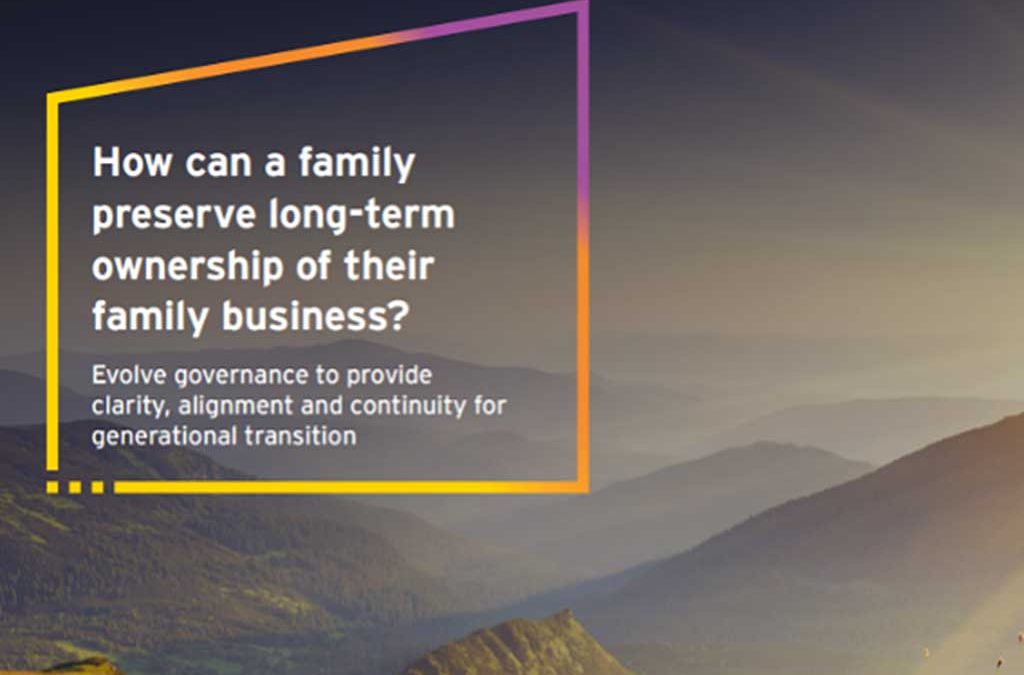
In our newly developed family board guide — How can a family preserve long-term ownership of their family business? — our professionals share insights on governance practices that can sustain both the enterprise and the family legacy.
Here are four key approaches — offering a preview of the leading practices explored more deeply in the guide — that every business-owning family should consider:
1. The power of parallel governance
As family enterprises grow, family and business decisions can become increasingly intertwined. A parallel governance model establishes clear boundaries by separating family ownership oversight from business governance.
Family councils, sometimes called owners’ boards, foster communication, education and next-generation development, while a professionalized board focuses on strategy, oversight and accountability. This approach preserves the family voice while enabling business leaders to focus on long-term performance and growth.
“One of the most impactful steps a family can take is separating family governance from business governance,” says James Bly, Managing Director, EY Family Enterprise Business Services. “When you create a family council alongside a more professionalized board, you give the family a voice without letting family dynamics dominate business strategy.”
2. Understanding the board’s purpose
While a formal board may not be necessary at every stage of a company’s evolution, it can play a critical role in preserving family ownership across generations.
A strong board prepares future leaders, promote shareholder accountability, provide stability through ownership transitions, strengthen strategy and enhance risk oversight while serving as a trusted adviser to management.
“For many business-owning families, establishing a board of directors can feel overwhelming and even like a loss of control,” says Dominic Venditti, Senior Manager, EY Family Enterprise Business Services. “But effective governance is about gaining clarity around decision-making rights, aligning expectations among stakeholders and supporting continuity through change.”
3. Choosing the right board members
Independent directors can strengthen board effectiveness by bringing outside perspectives and specialized experience. Families should identify the capabilities the business will need over the next three to five years and recruit directors whose experience complements the leadership team. Depending on strategic priorities, valuable skills may include growth, talent, M&A, AI and cybersecurity.
“The best boards aren’t built by filling seats with friends or peers,” Venditti says. “They’re built by objectively defining the qualifications and experience the business of the future needs and then casting a wide net to find the best candidates available.”
4. Building governance that endures
Effective governance is an ongoing process that should evolve alongside the family and the business. Families can strengthen governance by formalizing board expectations, promoting open communication, encouraging diverse perspectives and intentionally preparing the next generation for future leadership and governance roles. Some also create shadow board opportunities for younger family members to gain experience before taking on formal responsibilities.
“Governance isn’t a box to check,” Bly says. “It’s a living framework that should evolve as the family and the business evolve.”
Families that invest in governance proactively are often better positioned to navigate complexity, develop future leaders and preserve long-term ownership, strengthening both the business and the family legacy.
Summary
Governance structures should evolve as family enterprises grow and transition across generations. By taking a proactive approach, families can better manage complexity, prepare future leaders and preserve long-term ownership, strengthening both the enterprise and the legacy it supports.
For more information about EY Family Enterprise and our suite of services, visit ey.com/us/familyenterprise.
Learn more about how EY can help

About EY
EY exists to build a better working world, helping to create long-term value for clients, people and society and build trust in the capital markets.
Enabled by data and technology, diverse EY teams in over 150 countries provide trust through assurance and help clients grow, transform, and operate.
Working across assurance, consulting, law, strategy, tax and transactions, EY teams ask better questions to find new answers for the complex issues facing our world today.
EY refers to the global organization, and may refer to one or more, of the member firms of Ernst & Young Global Limited, each of which is a separate legal entity. Ernst & Young Global Limited, a UK company limited by guarantee, does not provide services to clients. Information about how EY collects and uses personal data and a description of the rights individuals have under data protection legislation are available via ey.com/privacy. EY member firms do not practice law where prohibited by local laws.
About EY Family Enterprise
As trusted advisors to ambitious business-owning families, including more than 90% of the world’s top 500 family enterprises, EY teams have the experience and know-how to support the entire family enterprise — family members, their family business, and their family office.
The EY approach to working with family enterprises is anchored in the EY Family Enterprise DNA Model. This model supports both the personal and business performance agendas of family enterprise leaders by pinpointing four key areas of focus to achieve their ambitions: family, values, business and assets. We combine our understanding of these focus areas with decades of experience working with the world’s most entrepreneurial families to create a framework for guided conversations on topics that matter most to family enterprise owners.
EY Family Enterprise professionals can support you in identifying and optimizing the drivers that impact family businesses’ growth and longevity, preserve wealth, and culture, and solidify intergenerational legacies. Family Enterprise Business Services | EY - US
We hope you've enjoyed this article. While you're here, we have a small favor to ask...
As we prepare for what promises to be a pivotal year for America, we're asking you to consider becoming a member.
The need for fact-based reporting of issues important to family owned businesses and protecting a lifetime of savings has never been greater. Now more than ever, successful families and family owned businesses are under fire. That's why Family Enterprise USA is passionately working to increase the awareness of issues important to family owned businesses built on hard work, while continuing to strengthen our presence on Capitol Hill. The issues we fight for or against with Congress in Washington DC include high income tax rates, possible elimination of valuation discounts, increase in capital gains tax, enactment of a wealth tax, and the continued burden of the gift tax, estate tax and generation skipping tax.
Family Enterprise USA promotes generationally owned family business creation, growth, viability, and sustainability by advocating for family businesses and their lifetime of savings with Congress in Washington DC. Since 2007, Family Enterprise USA has represented and celebrated all sizes, professions and industries of family-owned enterprises and multi-generational employers. It is a bi-partisan 501.c3 organization. Family foundations can donate.